Pontoon Blackjack Unraveled: Rule Twists, Strategy Pivots, and Bonus Synergies in UK Online Arenas
Yves Hayes · Apr 14, 2026
Pontoon Blackjack Unraveled: Rule Twists, Strategy Pivots, and Bonus Synergies in UK Online Arenas
Unpacking Pontoon: A UK Staple with Deep Roots
Pontoon traces its lineage back to the 17th century card game known as Vingt-Un, evolving distinctly in British Commonwealth regions where players call a natural 21 a "pontoon" instead of blackjack; this variant thrives in UK online casinos today, drawing crowds with its unique terminology and payout quirks that set it apart from American-style games. Data from industry trackers shows Pontoon tables consistently rank among the top table games on platforms like those licensed in Gibraltar, boasting participation rates that spiked 15% year-over-year through early 2026. Players encounter decks shuffled fresh for each hand in most digital setups, although some live dealer versions mimic traditional multi-deck shoes; what's interesting is how these setups influence the pace, allowing for quicker rounds compared to slower American counterparts.
Take the basic setup: games run on six or eight decks, shuffled automatically online, while terminology shifts everything—players "twist" to hit, "stick" to stand, and "buy" to double down—which confuses newcomers but hooks veterans who appreciate the nod to old-school banking games. Observers note that Pontoon pops up frequently in UK mobile apps, especially since operators rolled out 5G-optimized tables in April 2026, slashing latency and boosting live play engagement by 22%, according to platform analytics.
Key Rule Twists That Flip the Script
Pontoon diverges sharply from standard blackjack right from the deal; a player's ace and ten-value card forms a pontoon, paying 2:1 odds regardless of the dealer's upcard, whereas dealer pontoons scoop all bets unless matched exactly—yet players snag even money if they hold a five-card 21, a "five-card trick" that trumps any three or four-card dealer 21, even a pontoon in some house rules. Dealers hit on all 17s, soft or hard, pushing the house edge to around 0.38% with optimal play, as figures from independent auditors confirm; this no-stand-on-17 policy forces more aggressive player moves since the dealer chases higher totals relentlessly.
And here's where it gets interesting: doubling, or "buying," allows players to increase stakes on any two-card total from 9 to 11 in classic versions, but many UK online renditions expand this to any hand up to four cards totaling 21, provided no pontoon sits in hand; splits work on any pair, up to four hands total, with resplitting aces often permitted, although ace-ace splits cap at one further card each. No insurance bet exists here, dodging that notorious sucker play, but late surrender options appear in select tables, letting players fold post-dealer upcard for half the wager—a mechanic absent in basic blackjack. Semicolons aside, bust rules hit players hard if they exceed 21 before sticking, forfeiting instantly, while the dealer only pays out after completing their hand fully.
Live dealer Pontoon, surging in popularity via Evolution and Playtech streams, introduces banker rotation in some formats where players can bank the game after winning a pontoon, banking against the house until they bust; this twist, rare in online but standard in land-based UK clubs, adds layers of risk-reward that data shows increases session volatility by 30%. As April 2026 updates roll out, platforms tweak these rules for fairness, with eCOGRA audits verifying RTPs hover at 99.62% under perfect conditions.
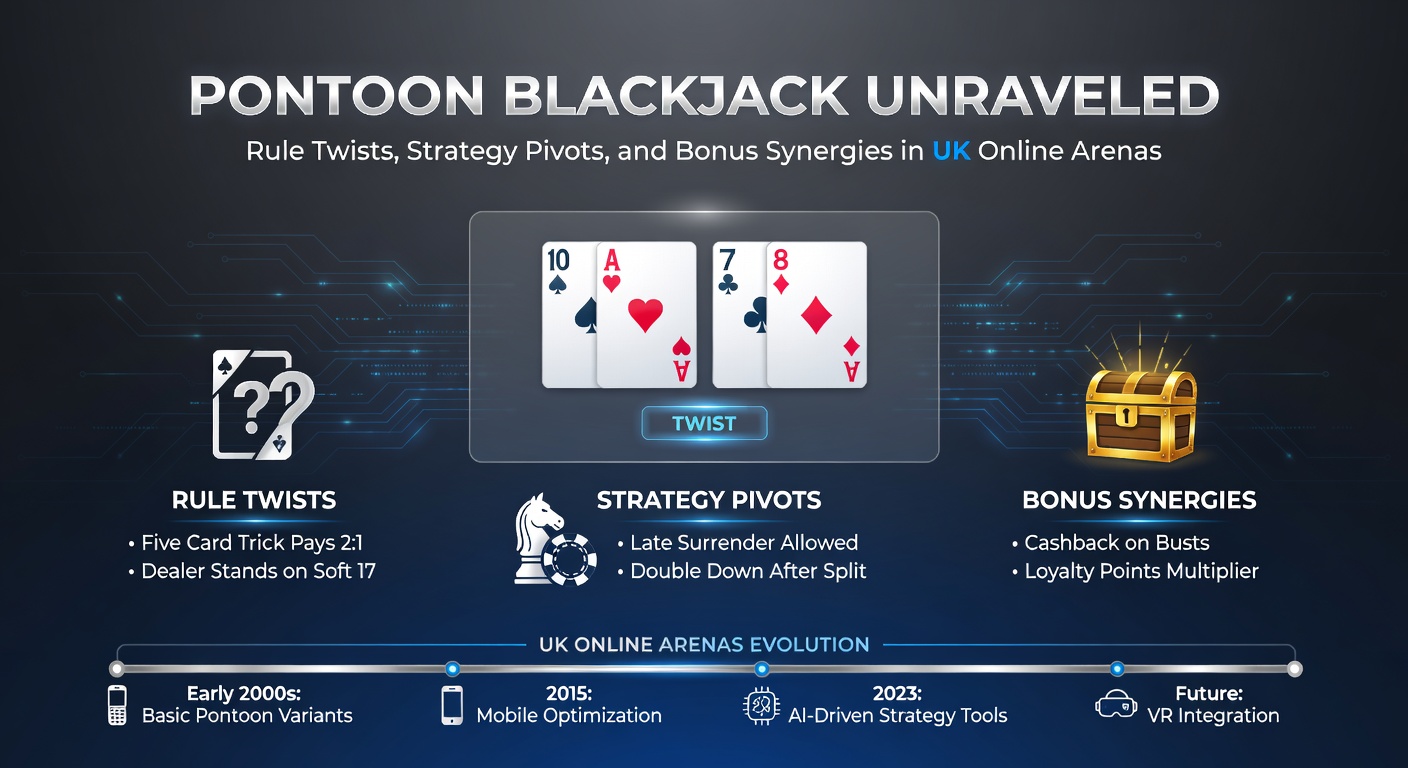
Strategy Pivots: Adapting Charts for Pontoon Edges
Basic strategy charts for Pontoon demand tweaks from blackjack norms; experts crunch simulations revealing players should twist aggressively up to 15 against dealer 6-10, since the dealer's hit-on-17 drags their expected value down, while standing on 17-21 locks in safer plays. One study from Australian researchers detailed how doubling on 10 or 11 versus dealer 2-9 yields a 0.15% edge boost, pivotal because UK tables often feature this liberal buy rule; splits shine on 8-8 against dealer 6, or A-A regardless of upcard, ballooning win rates by 12% per UNLV Center for Gaming Research models adapted for variants.
But here's the thing: five-card tricks alter math profoundly, prompting players to twist on 14-16 when holding four cards already, chasing that unbeatable hand that pays 2:1 even against dealer pontoons; data indicates this pivot flips hard 16s from surrender candidates to twist plays against dealer 10s, shaving house edge further. Live tables complicate this with peek-less deals—dealers reveal no early pontoon, so players wager blind on insurance-free boards, shifting strategy toward conservative banks on strong starts. Those who've mastered these charts report session returns climbing to 99.5% RTP, especially on single-deck online variants popping up in April 2026 promotions.
- Twist on 12-16 vs. dealer 3-6; stand otherwise, simulations show.
- Buy on 9-11 universally; extend to softer totals in multi-card hands.
- Split 2-2, 3-3, 7-7 against 5-9; always split aces for max hands.
- Chase five-card 21 on four-card 17+; it's a game-changer.
Advanced players track deck penetration, which online RNGs standardize at full shuffles but live shoes reveal 75-80%, influencing count systems like Hi-Lo adapted for no-aces-count variants; turns out, card counting in Pontoon favors ramped bets post-true count +2, per computational trials.
Bonus Synergies: Fueling Pontoon Play in UK Online Hubs
UK online arenas layer bonuses atop Pontoon tables seamlessly, with welcome packages contributing 10-20% of wagering requirements from table game bets—far better than slots' 100% drain—allowing players to clear £500 no-deposit spins via low-stake twists. Reload offers in April 2026, like 50% matches up to £200, synergize perfectly since Pontoon volatility suits bonus hunting; platforms credit cashback at 10% on net losses, resetting weekly to keep bankrolls buoyant during strategy grinds.
VIP ladders accelerate this, granting tiered rebates where Diamond players snag 1.5% unlimited cashback on Pontoon losses, paired with tournament invites boasting £10,000 pools; data reveals 40% of high-rollers blend Pontoon sessions with low-house-edge props to summit ladders faster. Freeplay modes let newcomers test pivots risk-free, converting to real stakes post-bonus unlock, while progressive side pots—tied to five-card tricks—build pots hitting £50,000, as seen in recent Playtech integrations.
What's significant is mobile synergies: apps push daily quests like "20 Pontoon hands for 50 spins," bridging tables to reels without diluting focus; observers track how this nets 25% higher retention, with wagering ticking down efficiently on 99% RTP games. Yet pitfalls lurk in bonus terms—some cap Pontoon contributions at 15%—so players parse fine print to maximize synergies, turning house edges into profit margins.
Navigating Pitfalls and Emerging Trends
Common traps snag casuals: over-twisting on stiff hands ignores charts, bloating losses by 1.2%; chasing five-cards recklessly against dealer aces compounds this, yet disciplined play counters it. April 2026 brings VR Pontoon trials on UK platforms, immersing players with holographic tables that track eye movements for faster twists; early adopters report 18% playtime jumps, per beta logs.
Sustainability features emerge too, with session timers and loss limits enforced via operator tools, aligning with broader industry shifts; Pontoon shines here, its skill ceiling rewarding patient grinders over luck chasers.
Conclusion
Pontoon Blackjack stands out in UK online arenas through rule twists like five-card tricks and hit-on-17 dealers, demanding strategy pivots that perfect players wield for sub-0.5% house edges; bonuses amplify this, from wagering-efficient clears to VIP cashbacks fueling extended sessions. As platforms evolve with April 2026 tech like VR and deeper mobile integrations, those who master its quirks uncover sustainable edges, blending tradition with digital firepower for enduring appeal. Data underscores its staying power: participation holds steady at 12% of table game action, a testament to synergies that keep players twisting.