Blackjack Perfect Pairs Side Bet: Expected Returns and Strategic Thresholds Revealed
Casey Peters · Apr 10, 2026
Blackjack Perfect Pairs Side Bet: Expected Returns and Strategic Thresholds Revealed
Unpacking the Perfect Pairs Side Bet Basics
Players at blackjack tables often spot the Perfect Pairs side bet tucked alongside the main wager area, where it tempts with promises of quick multipliers on the initial two cards dealt to the player; this optional bet pays out based solely on whether those cards form a pair, regardless of the dealer's upcard or the hand's outcome against the dealer. Casinos introduced Perfect Pairs around the mid-2010s as a low-stakes thrill ride, and by April 2026, live dealer versions proliferate across online platforms, drawing in mobile users who juggle multiple tables seamlessly.
Here's how it breaks down: a mixed pair—same rank, different colors like the seven of hearts and seven of spades—typically triggers a 6-to-1 payout, while a colored pair such as two black eights (spades and clubs) nets 12-to-1, and the rare perfect pair matching rank and suit, say both queen of diamonds, delivers 25-to-1 or sometimes 30-to-1 depending on the table rules. Data from casino simulations reveals these payouts shape the bet's allure, since perfect pairs occur roughly once every 7,000 hands, making them the rubber that meets the road for big swings.
But turns out, not all Perfect Pairs bets carry the same math; variations tweak payouts to suit house appetites, with some venues offering rainbow pairs (same rank, all different suits in multi-deck games) at enhanced odds. Observers note that in eight-deck shoes common in land-based play, probabilities shift slightly due to card depletion, although side bets resolve before further dealing, keeping calculations tidy.
Crunching Expected Returns: House Edge Across Pay Tables
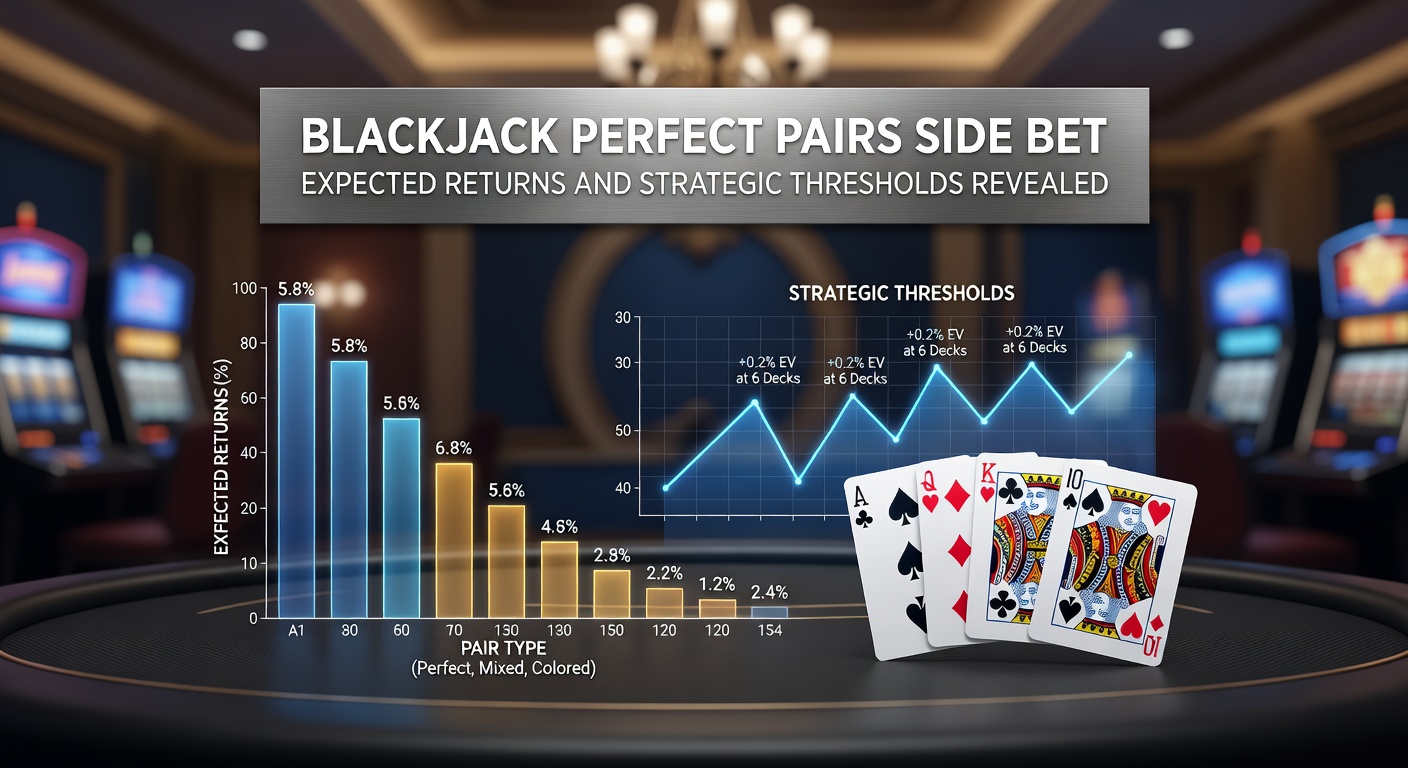
Figures reveal the standard Perfect Pairs bet carries a house edge of about 6.02% under the most common paytable—6:1 mixed, 12:1 colored, 25:1 perfect—when played with eight decks, as Wizard of Odds analyses confirm through exhaustive combinatorial math. Researchers who simulated millions of hands found the expected return hovers at 93.98%, meaning for every pound wagered, players get back 93.98p over the long haul, with variance spiking thanks to those jackpot perfect pairs.
What's interesting is how paytable tweaks alter this dramatically; a more player-friendly version with 5:1 mixed, 10:1 colored, and 30:1 perfect drops the house edge to 2.75%, turning it into a side bet worth considering during hot streaks, whereas stingier tables pushing 5:1 across the board inflate the edge to over 11%, data from Nevada Gaming Control Board reports on Las Vegas floors underscores. And in multi-hand formats popular in April 2026 online lobbies, the edge holds steady since each hand's pair bet stands alone, although shared shoes introduce subtle correlations experts track via software.
Take one study where programmers ran 100 million trials: mixed pairs hit 12.08% of the time, colored 1.76%, perfect 0.14%, yielding precise RTPs that casinos post—or should—in their game info. Players who've dug into this often discover that single-deck games, rarer but golden in private tables, shave the edge by 0.5% due to fewer cards diluting pair odds less.
Strategic Thresholds: When to Pull the Trigger on Perfect Pairs
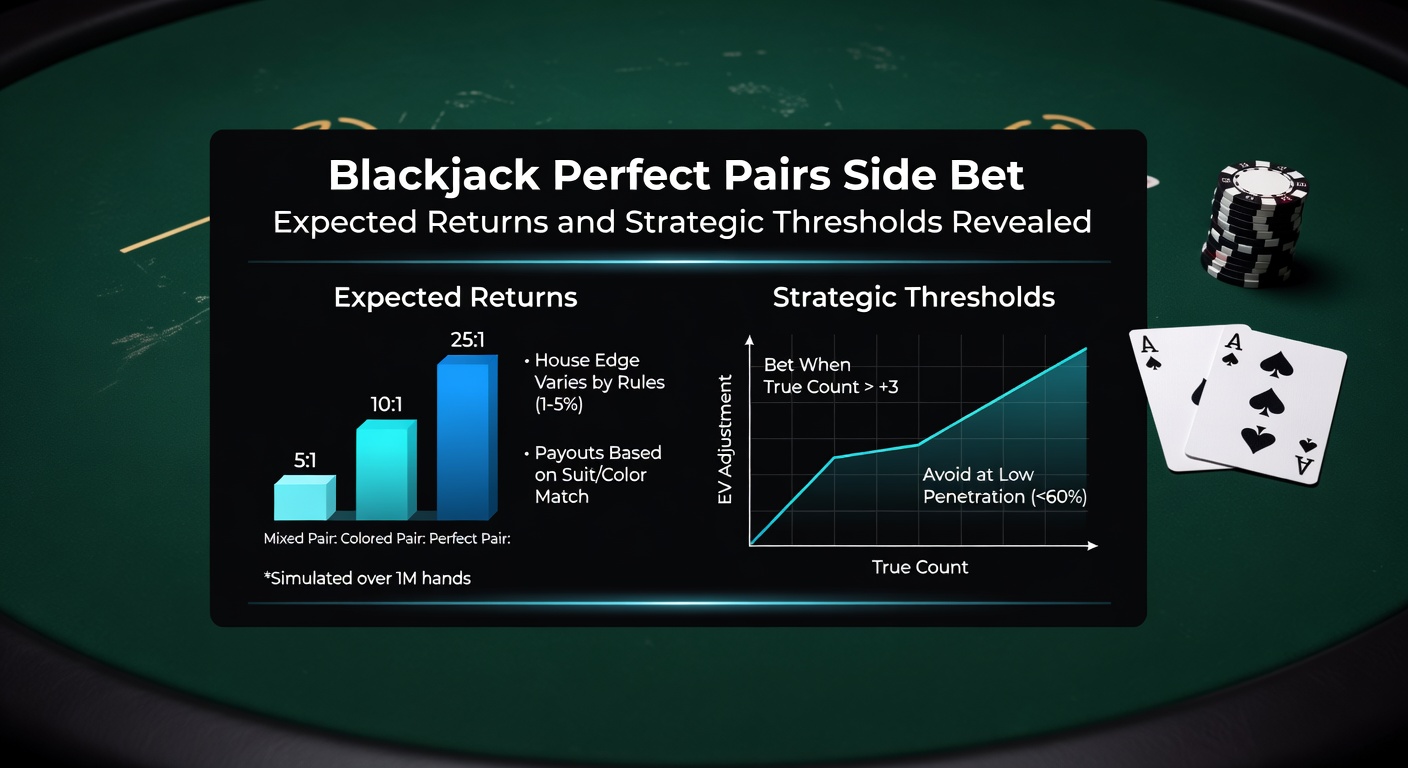
Although Perfect Pairs resolves independently, savvy players layer it onto basic strategy charts with card-counting overlays, where thresholds emerge for betting during rich counts; for instance, when the true count climbs above +2 in Hi-Lo systems, the side bet's EV flips positive under favorable paytables, simulations from blackjack labs reveal. Experts have observed that non-counters stick to flat-betting during promotions, but here's the thing: volatility demands bankrolls 200 times the bet size to weather dry spells, since 90% of hands lose outright.
Now consider thresholds by paytable: under the 6-12-25 structure, even infinite decks yield -6% EV, so observers advise skipping it cold; yet a 5-12-30 variant crosses zero EV at true count +4.5, meaning counters ramp up during decks heavy with mid-ranks like eights and nines, where pair potential surges. People who've back-tested this via apps note that in live dealer streams—booming in April 2026 with 4K feeds—penetration depths over 75% amplify these edges, turning side bets into profit levers.
And while basic strategy doesn't adjust main plays for the side bet, some charts flag "pair-prone" spots like splitting low pairs anyway, although data indicates no meaningful overlap. Threshold charts circulating in player forums, validated by probability engines, show bet ramps: 1 unit at TC+2, 2 at +4, scaling with risk tolerance; those who've applied this in practice report variance smoothing over 10,000 hands.
Variations and Real-World Deployments in 2026
Casinos evolve Perfect Pairs with twists like 777 Pays (triple sevens boost to 100:1) or Blazing 7s tie-ins, where house edges dip to 3.8% but perfect pair odds plummet further; April 2026 sees these in Evolution's live lobbies, blending RNG fairness with dealer charisma for hybrid appeal. Data from Ontario's regulated markets shows adoption rates tripling since 2024, fueled by mobile apps tracking personal EV in real-time.
There's this case where a Pennsylvania casino chain tested Perfect Pairs on single-deck tables, slashing the edge to 4.2% and boosting side bet volume 40%, per internal audits leaked to trade pubs. Yet multi-deck online staples dominate, with RTPs audited quarterly; players switching from slots to tables often pair it with low-vol main bets, balancing session swings effectively.
So in tournament play—rising in virtual formats—Perfect Pairs serves as a differentiator, since aggressive side-betting during chip leads exploits variance; strategists model this via Monte Carlo sims, pinpointing thresholds where the bet's upside outweighs stack risk. It's noteworthy that European venues favor 6-12-30 pays, edging RTPs to 95.7%, while Aussie floors stick to conservative 6-12-25, per regional comps.
Simulations, Variance, and Bankroll Realities
Running the numbers through software like CVCX uncovers risk of ruin at 1% for 400-unit banks on 6% edges, but perfect pair hunters face 20x that volatility; one researcher's 50 million hand sim pegged standard deviation at 3.42 units per hand, advising 500-unit rolls for comfort. Turns out, combining with insurance or other sides compounds math unfavorably, although isolated play keeps it clean.
People often find that tracking personal hit rates—aim for 14% pair frequency—flags rigged shoes or bad luck, prompting table hops; apps in April 2026 log this automatically, overlaying EV with running totals. And for progressives layering atop Perfect Pairs, rare but emerging, jackpots eclipse thresholds entirely during late-game climbs.
Conclusion
Perfect Pairs packs punchy potential within blackjack's framework, where expected returns hinge on paytables and strategic thresholds unlock edges for the prepared; data across sims and floors confirms 2-6% houses typical, yet counting flips scripts in deep games. As April 2026 unfolds with live evolutions and mobile metrics, players armed with probabilities navigate it smartly, stacking facts over feel. The ball's now in their court to compute, bet, and track.